

Click here for photos of this build
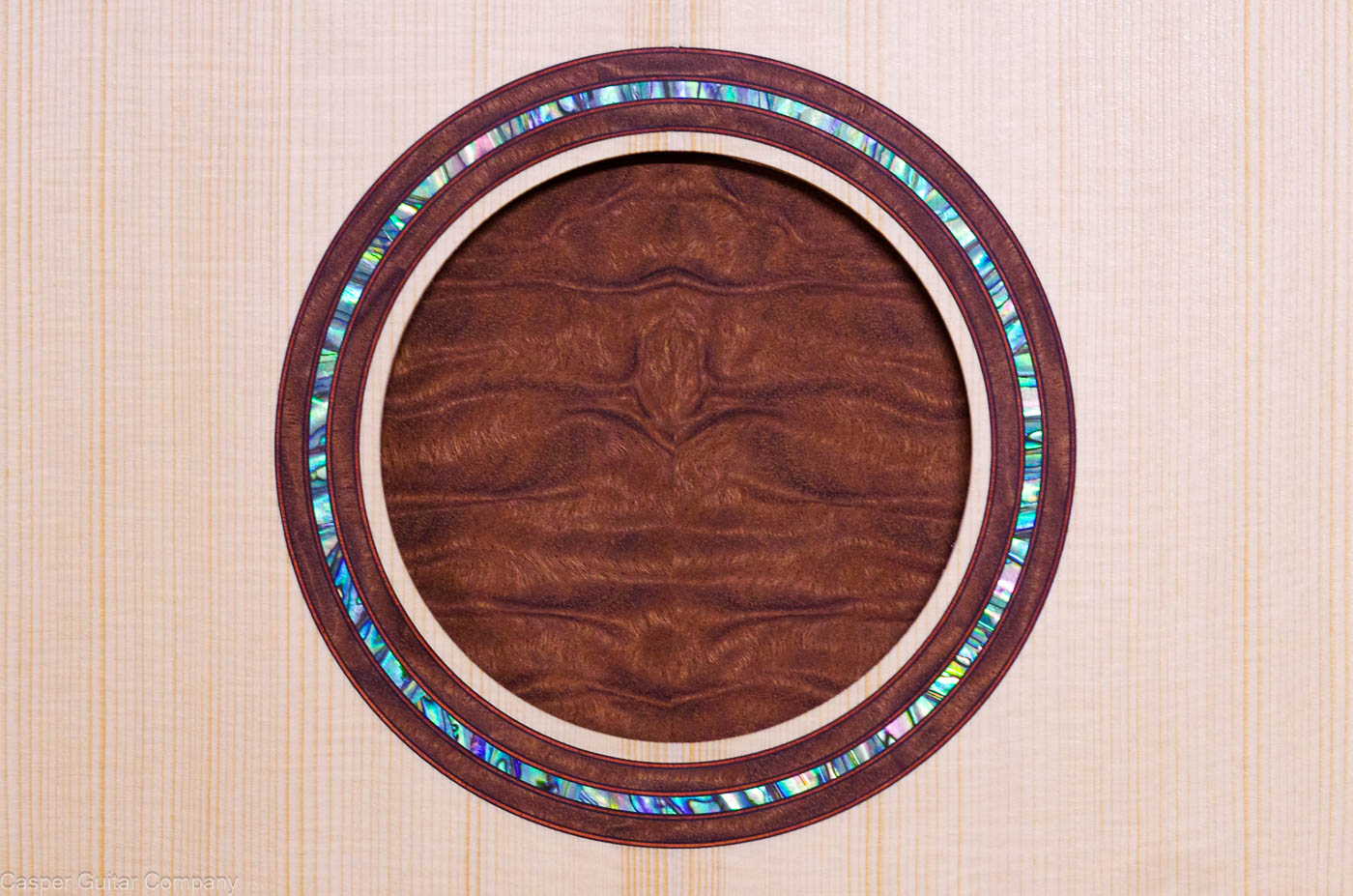
This build is a Michigan with some uber figured sapele for the back and sides and old growth Red Spruce for the top.
_________________________________________
Oct 13: The blog has languished while I finished up Travis’ guitar. I shot the lacquer several weeks ago then let the guitar cure for two weeks prior to level sanding and buffing out. Last week, I glued on the bridge, drilled and reamed the bridge pin holes, installed frets on the fingerboard, leveled and dressed them. Rather than glue down the fingerboard extension, I bolt it to the fingerboard extension platform on the neck block. I used the router to cut a pocket in the top for the tabs that I glued onto the fingerboard extension. I made a nut and a saddle and strung up the guitar! Always exciting to get strings on a new guitar. Nut slots and saddle were initially set on the high side. I put my ToneRite on the guitar Monday, which helps the guitar settle in a bit more quickly. Today, I dialed in the action and notified Travis the guitar was ready to ship. I snapped some glamour photos this morning and left the guitar with UPS for shipment.
Sep 8: I grabbed some fine sandpaper and leveled the pore filler. Prior to moving any further with finishing, I needed to locate the bridge. I measured where the bridge needed to be, and I laid down a mask the exact size of the bridge. This will keep lacquer off that part of the spruce top, so I have nice clean wood to glue the bridge to. I also masked the fingerboard and neck tenon and stuffed some paper towels in the sound hole to keep out the over spray. To seal the spruce top, I shot a couple of coats of sanding sealer on the top and one more on the rest of the guitar. I’ll start spraying lacquer next week.
Sep 7: I drilled the holes for the tuning machines and went over the entire guitar checking for sanding scratches. I put down a couple of swab coats of sanding sealer then worked through three applications of pore filler to smooth out the rosewood surfaces.
Sep 4: Time to wrap up Travis’ build. Yesterday, I glued a maple cap on the heel and start shaping and sanding the neck. I didn’t want to work around the heel until the glue cured, so I left that area alone. Today, I finished up shaping and sanding the heel. I hadn’t rounded over the binding, so I got my sanding block out and went to work on the maple binding. About the only thing left to do on the guitar itself was to drill holes in the headstock for the Gotoh tuning machines, so I headed over to the drill press and knocked that out. I want to have the bridge prior to shooting lacquer, so I can mask off the bridge area. I mounted a piece of ebony on the CNC and put it to work milling the bridge. Travis wanted some crescent moon inlays in the bridge, so while the bridge was on the CNC, I also had it mill pockets for mother of pearl moons. When done, I dropped in the inlays then sanded the bridge to 400G and used some fine steel wool to work in a good coat of wax.
Travis’ guitar is built! Ryan is coming into town this weekend to work on his build, so I won’t start the finishing process until next week.
Sep 2: I glued on the laminate for the face of the headstock that I had made over the weekend. Once the glue had cured, I installed the truss rod and glued on the fingerboard.
Sep 1: I used some sapele remnants to make a laminate for the back of the headstock. To mirror the back of the guitar, I bound the laminate with maple. Once done, I glued it on the back of the headstock.
Aug 31: I spent some time over the weekend with Rhino3D designing the headstock overlay for Travis’ guitar. I worked up a design with a lunar/celestial theme. I ran it by Travis, and he signed off. Today, I got to work on it. The very small inlays offered a good challenge, but the CNC handled the small pieces fine. I got the overlay finished up this evening after dinner.
Aug 27: Travis and I have traded a number of messages over the past week regarding fingerboard inlays. Travis wants inlays representing lunar phases. We came up with a design using mother of pearl and abalone. I worked up the design in my CAD program and wrote the routines for my CNC. Yesterday, I cut the inlays on the CNC. Today, I made the fingerboard. I ran a rough piece of ebony through my thickness sander to clean up each major surface. I first milled a 14′ radius along the top surface. I followed up with routines that milled pockets for the shell inlays and a channel for the bloodwood purfling. Prior to cutting the fret slots, I glued in the purfling, taking time to miter all corner joints. Once the glue had cured, I ran the last routine, which cut slots for the 20 frets.
I removed the fingerboard from the CNC and glued in the inlays. After the glue had cured, I used a long sanding bar to level the purfling and inlays.
While cutting the headstock profile for Joan’s guitar, I also cut the headstock profile for Travis’ guitar. I used my router with a pattern and pattern bit to cut the shape of the headstock on the neck of Travis’ guitar.
Aug 20: After a great mountain bike ride this morning, I had the rest of the day to work in the shop. I pulled my mortise and tenon jig from the shelf and clamped in the neck for Joan’s guitar. I have a pattern cutting bushing mounted on my router that guides the router around a pattern to cut both the mortise and tenon. As I built the guitar with a 2.1 degree slope from the soundhole to the neck joint, I needed to cut the shoulders for the neck tenon to have a matching 2.1 degree slope. The jig held the neck at this matching 2.1 degree angle so when the tenon was cut, the shoulders would have the proper angle. All this ensures the fingerboard plane will provide a nice low action.
After cutting the neck tenon, I drilled holes for the hardware needed to bolt the neck to the body. I also drilled holes in the mortise for the bolts to pass through from the body to the neck. Even though my jig cuts the proper shoulder slope at the neck tenon, the shoulders do not match the slight radius to the upper bout. I cut this radius using a chisel and flossed the joint with sandpaper. I worked through the process slowly, removing very small amounts from the shoulders until the neck fit tightly to the body.
Because the neck is milled with the fingerboard bed facing down, the CNC could not mill the 15 degree slope to the face of the headstock. The CNC did mill the back surface of the headstock, the front face, however, I cut on the bandsaw and followed up with the stationary belt sander. I removed just enough from the face so the forward edge of the nut rests right along the start line of the 15 degree slope.
Aug 18: I had some time on Friday to glue up the laminations for the neck. Today, I ran the neck blank over the jointer to level and square up the fingerboard bed. I put the neck in the vice on my CNC and milled a slot for the truss rod. I then flipped over the neck and mounted it on my CNC table so the heel and neck profile could be milled. A half inch end mill was used initially to rough out the shape and followed up with a ball mill to finish the surfaces. Later, I will use the router to cut the tenon on the heel, and I’ll cut the face at a 15 degree angle using the bandsaw.
Aug 14: Squeezing in shop time when I can. I had just enough time this morning to level the binding and purfling along the rims and give the whole body a good sanding to 220G. I need to round over the binding outer corner and route the mortise for the neck, but otherwise the body is done.
Aug 13: I removed the tape that was used to hold the binding and purfling in place and using a scraper, I leveled the binding and purfling along the top and back. I still need to level the bindings along the rims, which I hope to get to tomorrow. We have family in town and the day was too nice to not be on the lake. I did take some time to glue up some mahogany and maple laminations for the neck.
Aug 11: Today, I glued in the binding and purfling around the perimeter of the back. As with the top, these pieces are all glued in at the same time. I start at the lower bout, aligning the pieces to the center of the tail graft, then work my way around one side, gluing and taping until I reached the upper bout. I repeated the process up the other side of the back. Once on, I wrapped the body tightly in twill tape to snug the binding and purfling close to the body.
I need to get the neck blank glued up, so I pulled some mahogany from storage and cut pieces for both Travis’ and Joan’s guitar necks.
Aug 10: I have a couple of days before the next visitors arrive, so I am hoping to get bindings on Travis’ guitar. Today, I got the channels routed along the top and back perimeters for the binding and purfling. Travis wants curly maple for the binding, and we are using bloodwood for purfling. I cut a thin slice from the side remnants to use as trim around the top. All of these pieces were put in the bender. I glued in a curly maple tail graft and had enough time left to glue in the binding, purfling, and trim strip around the top of the guitar.
Jul 22: I had a bit of time and was all dusty after leveling the binding on Joan’s St Clair, so I grabbed the body of Travis’ Michigan and level sanded the sides. Often, sides will have small undulations after being bent. These need to be sanded out and the rims leveled prior to routing the channels for the binding and purfling. If I sand them out after installing the binding, the binding will end up narrower in the areas that I needed to level. The body is now ready to be routed for binding and purfling.
Jul 4: Holiday today, but we didn’t have much going on this morning, so I glued the top to the rims. With that, the box is closed…yay! I don’t have enough bloodwood purfling for Travis’ guitar, so I needed to make some more. I ripped a strip of bloodwood and ran it through my thickness sander to take it down to .02″ thick. I then sandwiched it between some black fiber and clamped it nice and tight while the glue dried. It will be resawn later into thin strips.
Jul 3: Today is brace carving day. I voice the top by removing wood from the braces, listening to the top as I tap near the bridge location, and measure how much the top deflects under a fixed amount of weight. Each top, even from the same species of spruce, has its own weight and stiffness characteristics. The only way to bring out the best of each top is individually voice it. I worked with the chisel until I was happy with how the top was responding. I then cleaned up the top with some sandpaper. I don’t particularly voice the back. Rather, I shaped the braces somewhat like an inverted V. This lightens the braces while still keeping them stiff. I do this with a small thumb plane and follow up with sandpaper.
With the back braced, I fit it to the rims. I notched the rims to allow the end of each brace to pass through the rim. I then glued and clamped the back to the rims.
Jul 2: I had a few braces to get on the top. One being the upper transverse brace. This brace runs across the upper bout above the sound hole. I design my neck block with a fingerboard extension support that butts into this brace. The trick is getting the brace glued into position. I first notched the top to let the ends of the X braces through the rims. I made the upper transverse brace and notched the rims so the brace butted tightly against the neck block. Once I was happy with the fit, I put the upper transverse brace in place on the rims, fitted the top, then reached in through the sound hole, and grabbed the brace firmly against the top. I lifted the top and marked the location of the brace. I put the top back in my go bar deck, and glued in the upper transverse brace, sound hole reinforcements, and a couple of finger braces that sit above the upper transverse brace.
I ran the back through the thickness sander to clean up the back inlays and finished up with the random orbital sander. Then I went back to the thickness sander to remove material from the inner part of the back until I had the back at the proper thickness. A little work with the random orbital sander, and the back was ready for braces. I first glued down a cedar strip to reinforce the joint where the two panels were joined for the back. The four mahogany back braces pass through this cedar strip. I used a small razor saw and chisel to remove a section of the reinforcement strip so the brace could sit firmly against the back all the way across. The back braces were then glued and clamped.
Jul 1: I ran the top through the thickness sander to clean up the rosette then flipped the top over and sanded material from the back side of the top until the top was at the desired thickness. I dropped the top on the CNC and cut the sound hole. With the rosette done and top at the desired thickness, the top was ready for bracing. I use hide glue to attach the braces and plugged in the glue pot while I joined the X braces and laid out the bracing pattern on the top. I first glued down the bridge backing plate then followed up with the X brace, tone bars, and finger braces.
Travis saw the split inlay I have used previously on the back of some guitars and asked for the same for his guitar. I had previously cut the needed paua abalone strips, so I mounted the sapele back to my CNC table and cut pockets for the shell. Once I had inlaid the shell and the glue had cured, I cut thin channels for bloodwood purfling and inlaid those strips. I’ll level the inlays later then sand the back to the desired thickness prior to gluing on the back braces.
Jun 30: Ryan was in town for a long weekend and wanted to work on his guitar build, so I didn’t get any time to work on Travis’ guitar until today. The goal for the day was to get the rosette inlaid. Following nine holes of golf this morning with my wife, I headed for the shop. Travis wants one of my more popular rosettes that use two rings of wood from remnants of the back with a single ring of abalone shell in the middle. Once the back is cut out, the remaining wood is not large enough for a single wood ring. But I can cut small sections that can be pieced together to form the circle. I lined up the wood, so the grain ran from the outer edge of the rosette toward the sound hole and cut 16 identical pieces on the CNC. I also cut arcs of abalone that would by joined to form the center ring. With the wood and shell cut, I mounted the red spruce top on my CNC and cut a pocket for the wood ring. I glued in the sapele pieces to form the wood ring, ensuring that each piece fit very tightly to the adjoining piece. After the glue had dried, I cut the pocket for shell using the CNC and inlaid the abalone pieces. Lastly, I had the CNC cut channels for the four bloodwood purfling rings and inlaid each ring. Tomorrow, I will run the top through the thickness sander to clean up the rosette.
Jun 22: I had a little time today to sand the linings. I will be building the back with a 15′ radius to provide some humidity change protection. To provide a matching radius gluing surface, I sanded the face of the back linings with a 15′ radius bar, making sure to also slope the upper and lower bouts, so the top has a 15′ radius in all directions. The top linings were sanded flat, but I used a small block plane and a sanding bar to slope the rims downward from the waist to the neck block. The slope is equal to 2.1 degrees, which will give a nice fingerboard plane for a low action. The last step with the rims was to glue in some reinforcements a various places around the rims. The idea is these can help stop a crack from opening up further if the guitar is dropped. I have no experience whether they help or not, but the do stiffen the rims a bit, which I do believe is a good thing.
Jun 20: I sanded the inside of the rims, glued and clamped the tail block. Once dry, I glued in the neck block. While the glue was curing on the neck block, I ran the top and back through the thickness sander to clean them up following glue up. The joints look near invisible. Just the way I like them. I need a good base to glue the top and back to the rims. To provide this base, I glued in mahogany linings around the inside edges of rims.
Jun 19: I am using some old growth red spruce for the top of Travis’ guitar. The set I have has a few knot intrusions, so I used a template to make sure I had a good, clear area for the top. I then cleaned up the two edges to be joined, brushed on some glue, and put the top in my joining jig.
I usually have some neck blocks and tail blocks for each of my models made up. But going through my stock, I had neither for the Michigan, so I had to make some more. I cut out rectangular blocks from mahogany. As the top of the upper bout and bottom of the lower bout are radiused, I needed a matching radius on one face of the blocks. The easiest and most consistent way of doing this is with my CNC. After milling the radius, I cut a 2.1 degree slope in the top of the neck block and glued on piece of mahogany that supports the fingerboard extension under the spruce top. The slope is required to tilt the fingerboard plane slightly back and away from the top to get proper distance between the strings and the frets.
Jun 18: I got Travis’ Michigan started today. Years ago, I purchased a flitch of some of the most gorgeously figured sapele I have ever run across. Travis wants to use a set of this wood for his guitar. I pulled a set from the flitch and ran it through the thickness sander a few times to clean up the surfaces so I could see the grain well. Given the figure, I wanted the two back plates bookmatched perfectly when gluing. Once I determined which edges to join, I ran the joining edges through the table saw to clean them up and used a long sanding bar to sand the facing edges dead flat. I have a jig for joining panels that holds the joining edges down while pushing the joints together. A little glue, and I had the panels joined and sitting in the jig.
The sides were overly thick, so I ran them through the thickness sander to get them down to a bendable thickness. I then hit both the inside and outside faces with the random orbital sander to remove the thickness sander scratches. I spritzed a side with water and dropped it in the bender. After the side had cooled, I clamped it inside the building mold, which helps maintain the shape, and repeated the process with the other side

Travis
August 21, 2026 6:55 pmKenneth, you are bringing to life my dream guitar and it’s looking so amazing!!!! Such Beautifull workmanship and i am amazed every time i get on here to check the progress of the builds you are doing!!!
Kenneth Casper
August 23, 2026 10:15 amThanks Travis. The guitar is coming along nicely 😊
Micah Gargala
September 1, 2026 9:56 pmIt’s. been a lot of fun tracking your builds over the summer…those fretboard and headstock inlays are stunning!
Kenneth Casper
September 1, 2026 10:05 pmThanks Micah! Both guitars are nearing the finish line!